Overview
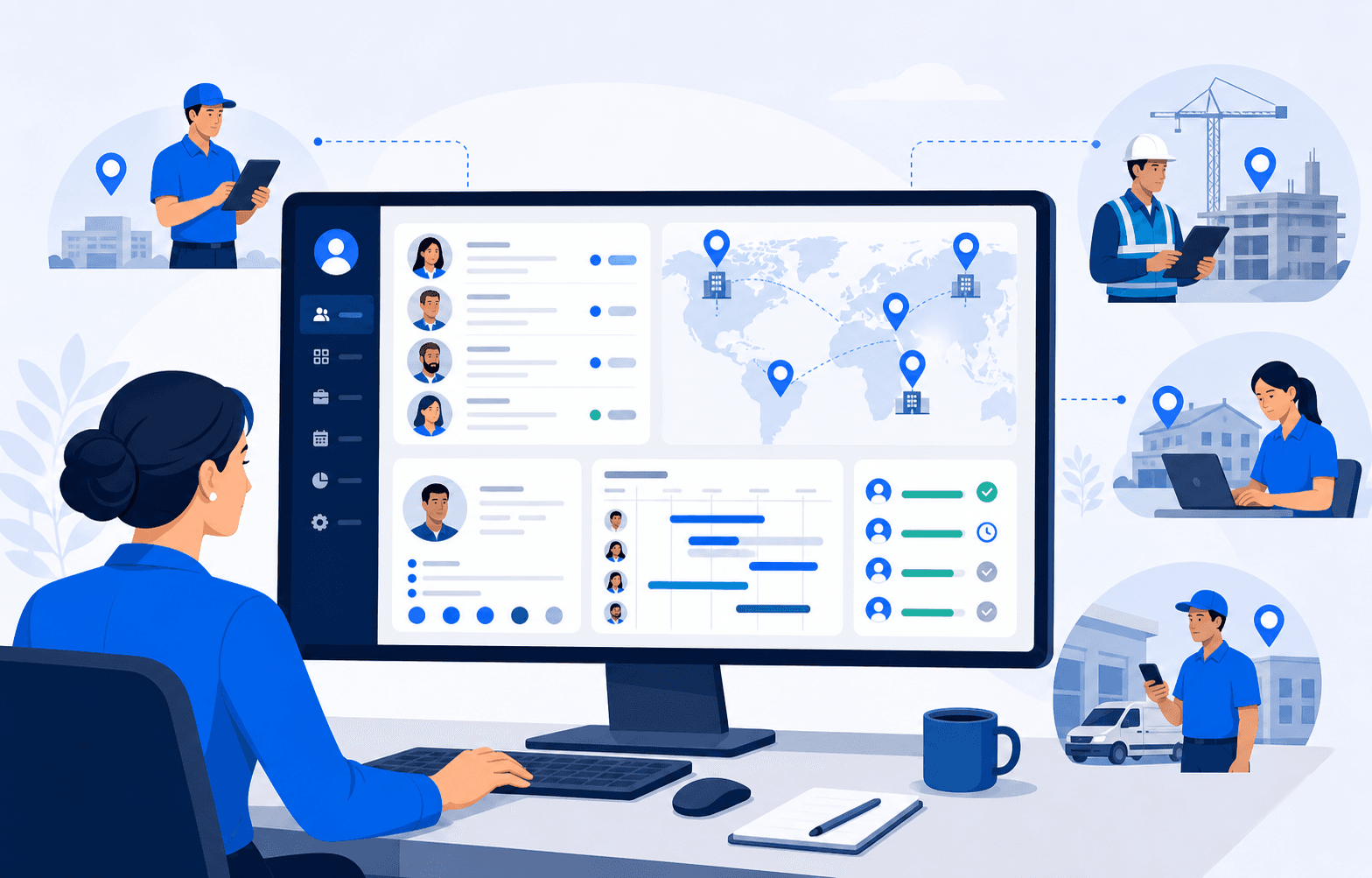
A workforce distributed across sites and cities produces records in several operational contexts at once, employee details in one place, wage information in another, site logs and payment activity somewhere else again, and without a shared system, administrators end up reconciling spreadsheets just to understand what is currently happening across the business. Blue Sky needed a single administrative surface covering employees, wages, work sites, cities, payments, and workforce tracking, without presenting itself as a statutory payroll or compliance product it had not been built and confirmed to be. iEncode Tech's brief was not to add another point tool to an already fragmented set, but to give operational leaders one consistent, honestly scoped way to see how the business actually runs across locations.
Where the operational gap came from
Distributed workforce operations tend to accumulate tools the way an organisation grows: a spreadsheet for one site becomes a habit, a second site gets its own version, and wage or payment records live wherever whoever managed them last found convenient. None of that is a failure of any one person's judgement, it is what happens by default when there is no shared structure for location-based work. By the time an organisation is running multiple sites across multiple cities, the cost of that drift shows up as an administrator's time: comparing one site against another, or checking wage activity against workforce presence, means opening several disconnected records rather than one connected view.
The core challenge
Bringing employee, wage, site, city, payment, and tracking data into one platform surfaced problems a single-location tool never has to solve:
- Employee, wage, and payment records existed in separate operational contexts with no shared structure connecting them
- Work-site and city information was often informal or unstructured, which made it difficult to filter or report on location-based activity with any confidence
- Administrators needed one dashboard view without collapsing the meaningful differences between an employee record, a wage record, and a payment record
- Any wage or payment feature had to be scoped honestly, since the engagement did not include verified statutory payroll or jurisdiction-specific compliance work, and the platform could not imply otherwise
- The system needed to remain usable as the number of sites, cities, and employees grew, rather than being built around whatever dataset happened to exist at launch
Discovery and what success needed to look like
The starting point was treating the problem as one of information architecture before it became a screen-design exercise: what are the real entities in a distributed workforce, employee, work site, city, wage, payment, and how do they actually relate to each other in daily operations. That question mattered more than any individual dashboard widget, because getting the underlying structure wrong would have meant rebuilding the reporting and filtering logic later. Success was defined narrowly and honestly: administrators needed to move between a location-level view and an individual employee or payment record without losing context, and the platform needed to represent wage and payment activity accurately without ever implying a compliance guarantee that had not been verified as part of the engagement.
Solutions
iEncode Tech modelled work sites and cities as first-class structured entities rather than free-text fields attached to an employee record, which is what makes it possible to filter and report by location at all. Employee, wage, and payment records were then connected to those structures, giving administrators a shared frame of reference across what had previously been separate operational areas maintained on their own terms.
The administrative dashboard was built to surface related records together without merging their distinct purposes: an administrator reviewing a work site can see the employees, wages, and payment activity connected to it, while still opening each record type on its own terms rather than through a single flattened view that hides what kind of record they are actually looking at. Workflow design work focused specifically on reducing the number of steps needed to move from a location-level view down to an individual employee or payment record, since that movement, checking a site, then a person, then a payment, is what an operational administrator does most often in a working day.
Designing the administrative experience
Because the primary user is an administrator working through this dashboard for extended periods, not a casual visitor, the interface prioritised data density that stays legible over decorative simplicity. Site and city views were designed as the entry point into the platform, reflecting how administrators actually think about the business, location first, individual records second, rather than starting from a generic employee list and expecting administrators to filter their way to a useful view. Mobile access through React Native supports administrators and field-based staff who need workforce or site information away from a desktop, while the core reporting and record-review work happens through the web dashboard where a larger screen suits the density of the data involved.
Building the platform
Administrative dashboard
A single, Next.js-powered dashboard brings employee, wage, site, city, payment, and tracking records into one connected view, letting administrators move between a location-level summary and an individual record without switching tools.
Work-site and city structures
Sites and cities are modelled as their own structured records rather than descriptive text, which is what allows the platform to filter, group, and report by location in a way an unstructured field never could.
Employee and wage management
Employee records and wage information are connected directly to the roles and locations they apply to, giving administrators one place to review workforce composition alongside compensation context.
Payment module
A payment module handles operational payment activity connected to employees, wages, and sites, deliberately scoped to operational tracking rather than presented as a statutory payroll or compliance system.
Real-time workforce tracking
WebSocket-based updates keep activity visible across sites and cities as it happens, so an administrator's dashboard reflects current status rather than a snapshot that may already be out of date.
Communication and alerts
WebRTC-based in-app calling lets administrators reach site-level staff directly from the platform, while Google-based authentication and analytics, Firebase push notifications, Zoho Mail, and an SMS gateway keep relevant people informed of payment and workforce events.
Technology and architecture
- Frontend: Next.js powers the administrative web dashboard, chosen for fast page loads and a solid foundation for a data-dense interface administrators use throughout the working day.
- Mobile: React Native supports mobile access for administrators and field-based staff who need workforce and site information away from a desktop.
- Backend: Node.js runs the API layer, keeping the stack consistent in JavaScript across web, mobile, and server for faster, more coordinated development.
- Database: MongoDB stores employee, wage, site, city, and payment records in a flexible document model that accommodates each operational area's distinct shape without forcing everything into one rigid schema.
- Real-time and communication: WebSockets keep workforce and site activity current in real time, and WebRTC enables in-app calling between administrators and site-level staff.
- Supporting services: Google APIs and Firebase handle authentication, analytics, and push notifications; Zoho Mail and an SMS gateway deliver alerts; Vercel hosts and deploys the dashboard; Cloudinary manages document and image assets connected to employee and site records.
Where the build got hard
The hardest design decision in this engagement was resisting the temptation to build a single, flattened dashboard that merged employee, wage, site, and payment data into one generic table. That approach would have been faster to build but would have obscured exactly the distinctions that make the data useful, a wage record is not the same kind of thing as a payment record, even though they are related. Modelling them as connected but distinct entities took longer upfront but is what lets an administrator trust that a number on screen means what it claims to mean.
The second genuine difficulty was scope discipline around payment functionality. It would have been easy to let a payment module's description drift toward implying payroll compliance, since the two concepts sit close together in a reader's mind. Every description of the payment module was deliberately written to describe operational payment tracking rather than statutory payroll processing, because the engagement never included the jurisdiction-specific verification that a payroll-compliance claim would require.
Results and impact
The solution centralised distributed workforce administration, bringing employees, wages, work sites, cities, payments, and tracking into one platform instead of scattered spreadsheets and site logs. Administrators gained a consistent way to review workforce activity across locations without losing the operational detail specific to each site or city, and real-time tracking meant that view reflected current activity rather than a delayed snapshot.
The platform is described here strictly as an operational workforce management system. It does not claim jurisdiction-specific payroll compliance, since that was not part of the confirmed engagement scope, and no such claim should be inferred from the payment module's presence.
What this project reinforced
Structuring location as a first-class entity, rather than a descriptive field on an employee record, is the decision that made every other reporting and filtering capability possible. It is a pattern worth carrying into any enterprise or workforce system where an organisation operates across more than one physical location, and it connects directly to the same multi-role portal thinking behind iEncode Tech's workforce management work more broadly.
Managing people and pay across multiple sites through disconnected spreadsheets? Contact iEncode Tech to discuss a centralised workforce platform scoped honestly to what your organisation actually needs, or see the Blue Sky project overview for a portfolio-style summary of the build.