Overview
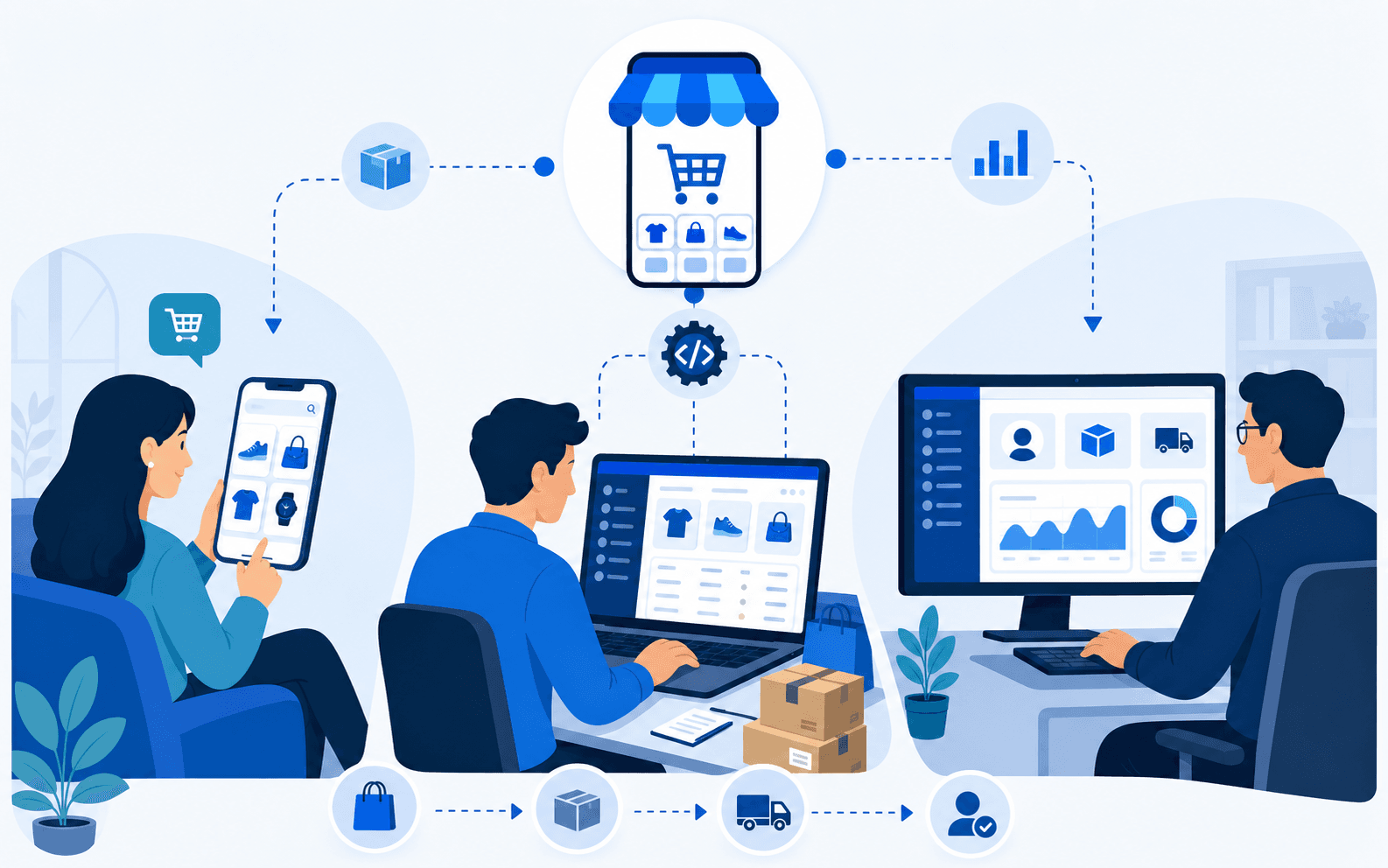
A customer, a seller, and an administrator may all touch the same products and orders on MyKart, a US e-commerce platform, but they do so for entirely different reasons and need entirely different tools to do it well. Before this engagement, the challenge was architectural rather than visual: how do you preserve one accurate, shared source of truth for products and orders while giving each of three very different users an interface actually suited to their responsibilities, instead of forcing all three through a single generic commerce dashboard. iEncode Tech built a React Native customer application alongside separate seller and administrator web portals, all coordinated through a shared Java and Spring Boot backend. The decision that shapes this whole case study is where the platform draws its role boundaries, and why.
Where the requirement came from
Within iEncode Tech's e-commerce work, platforms often start as a single storefront and grow seller or admin tooling onto that same interface later, which tends to produce a compromise: neither the shopping experience nor the operational tooling is genuinely well suited to the person using it. MyKart's brief avoided that path from the outset by treating customer shopping, seller operations, and platform administration as three distinct product problems from day one, connected underneath by shared data but never forced through a common interface just because they happened to touch the same records.
The core challenge
Building one commerce platform for three roles surfaces architectural pressure that a single-audience storefront never has to resolve:
- Customers needed a fast, focused mobile shopping experience without seller or admin complexity leaking into it through shared screens or unnecessary options
- Sellers needed practical product and order management tools distinct from the customer-facing catalogue, built around managing inventory and fulfilling orders rather than browsing them
- Administrators needed platform-level oversight without duplicating the seller or customer experience, or requiring a third, separate application to maintain
- All three roles had to work from the same underlying product and order data, so information could never drift between interfaces and create disagreements about stock or order status
- The mobile customer experience and the web-based seller and administrator portals needed to be coordinated by shared backend logic rather than built as three disconnected systems that happened to share a database
Discovery and defining the goals
Discovery centred on mapping what each of the three roles actually does with a product or an order, not on assuming a generic e-commerce feature list would cover all three. A customer cares about discovery, price, and delivery; a seller cares about stock levels, order fulfilment, and listing accuracy; an administrator cares about platform health and oversight across every seller and customer on the system. Once those responsibilities were mapped clearly, the goal became specific: build three interfaces that never force a user to look at controls meant for someone else, while guaranteeing that a change made in one interface, a seller updating stock, for instance, is reflected accurately and immediately everywhere that same data is used.
Solutions
iEncode Tech separated the three experiences at the interface level while unifying them underneath through shared backend APIs. The React Native application handled the customer mobile experience end to end, giving shoppers a focused discovery-to-order journey without exposing seller or administrative functionality anywhere in that flow. Seller and administrator portals were built as their own web experiences, each scoped to the controls that role actually needs, product and order management for sellers, platform-level oversight for administrators, rather than a shared dashboard with permission toggles hiding irrelevant sections.
Java and Spring Boot services coordinated the application rules that all three surfaces depend on, backed by a MySQL data model that kept product and order information consistent regardless of which interface touched it. Role separation reduced unnecessary complexity in each individual interface without fragmenting the underlying platform, and shared APIs kept data synchronised across mobile and web without requiring redundant integrations built three separate times.
Designing three different experiences from one product
Customer-facing design prioritised speed to purchase: minimal friction between discovering a product and completing an order, on a screen size and interaction pattern suited to mobile shopping. Seller-facing design prioritised clarity of current state, stock levels, pending orders, at a glance, since a seller checking the portal is usually trying to answer a specific operational question rather than browsing. Administrator-facing design prioritised oversight without redundancy, giving platform-level visibility without recreating either the customer catalogue view or the seller's operational tools inside a third interface.
Building the platform
Customer mobile application
A dedicated React Native application gives customers a focused shopping journey, from product discovery through checkout, without any seller or administrative functionality visible anywhere in that path.
Seller portal
Sellers manage products and fulfil orders through their own web interface, scoped specifically to operational tasks, inventory, listings, order status, rather than a general-purpose dashboard shared with other roles.
Administrator portal
Administrators oversee the platform through tools built for platform-level visibility, distinct from both the customer and seller experiences, without duplicating either one.
Shared backend and real-time updates
A common Java and Spring Boot API layer, backed by MySQL, keeps product and order data consistent across every interface, with WebSockets pushing real-time order and inventory status so a stock change or order update reaches customers and sellers immediately rather than on the next manual refresh.
Communication and notifications
WebRTC supports in-app calling between customers and sellers for resolving order questions without leaving the platform, while Google APIs, Firebase, and an SMS gateway handle sign-in, analytics, push notifications, and time-sensitive account or order alerts.
Technology and architecture
- Mobile: React Native builds the customer application from one codebase for iOS and Android, keeping the shopping experience consistent without duplicating development effort across platforms.
- Backend: Java and Spring Boot form the application layer, giving MyKart a strongly typed, enterprise-grade foundation for the business rules governing products, orders, and role-based permissions across all three surfaces.
- Database: MySQL stores commerce data relationally, keeping products, orders, and inventory consistent across every interface that touches them.
- Real-time and communication: WebSockets push real-time order and inventory updates to customers and sellers, and WebRTC supports in-app calling between them.
- Supporting services: Google APIs and Firebase provide sign-in, analytics, and push notifications; an SMS gateway sends time-sensitive alerts; AWS (EC2, Lambda, S3, Route 53) hosts the platform, runs background and serverless order-processing tasks, stores product imagery, and manages DNS.
Where the build got hard
The hardest problem was not building any single interface, it was guaranteeing that all three stayed synchronised without introducing lag or inconsistency a user would notice. A seller updating stock while a customer is mid-checkout is an ordinary occurrence at any real commerce volume, and the platform had to handle that overlap correctly rather than occasionally showing a customer a product that had just gone out of stock. WebSocket-based updates addressed this directly, propagating inventory and order changes to affected interfaces in real time rather than relying on customers or sellers to manually refresh and catch a stale view.
The second genuine difficulty was keeping the three interfaces meaningfully different without letting them drift into inconsistent design language or duplicated logic. Sharing backend APIs made this easier than building three disconnected systems would have, but it still required deliberate discipline to keep, for example, order-status logic defined once in the backend rather than reimplemented slightly differently in the customer app and the seller portal.
Results and impact
MyKart became one coordinated platform with three purposeful experiences instead of a single interface stretched across incompatible needs. Customers, sellers, and administrators each work from an interface built for their responsibilities, while shared APIs and structured data keep product and order information consistent across every surface, without suggesting unverified logistics or payment integrations that were not part of the confirmed scope.
The project demonstrates iEncode Tech's capability in mobile commerce, multi-role portal design, role-aware workflow architecture, API engineering, and relational data management for platforms that need to serve genuinely different audiences from one shared foundation.
What this project reinforced
Role separation at the interface level, backed by one shared source of truth underneath, scales better than a single dashboard with visibility toggles, because it lets each experience evolve independently without risking the others. That principle now shapes how iEncode Tech approaches any multi-role platform or e-commerce build, including the three-sided marketplace work behind SewaMart.
Building a commerce platform that needs to serve more than one type of user well? Contact iEncode Tech to discuss a role-aware architecture built around your actual operations, or see the MyKart project overview for a portfolio-style summary of what shipped.