Overview
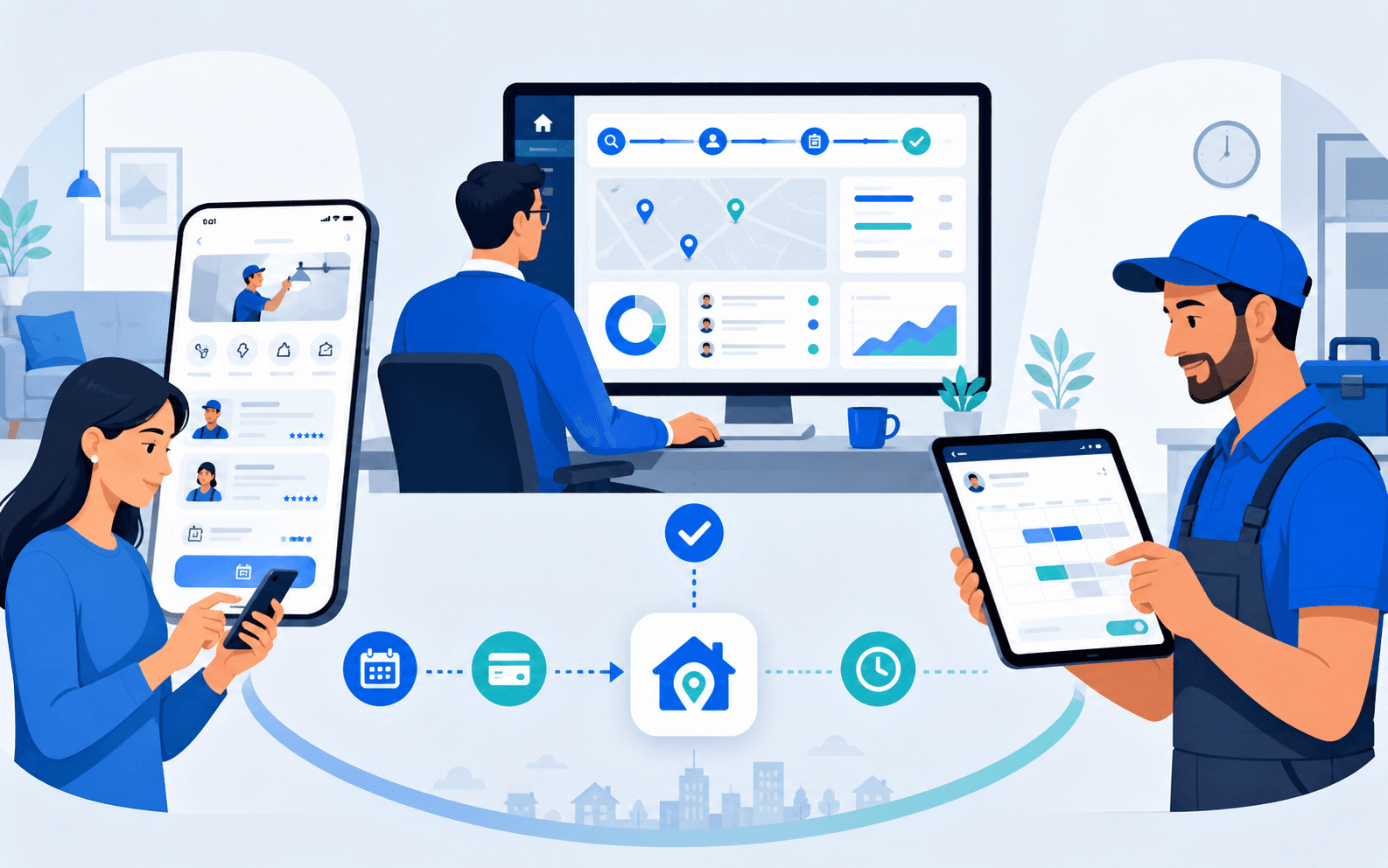
A local-services marketplace only works when supply and demand can meet through a platform that both sides actually trust enough to use, which means customer discovery, provider onboarding, and administrative oversight all had to be designed together from the outset rather than as a customer-facing catalogue built first with provider tools retrofitted around it later. SewaMart needed all three sides of the marketplace, and the brand holding them together, to launch as one coherent product rather than a sequence of separately shipped features. iEncode Tech delivered the engagement end to end: brand identity, UI/UX design, a Next.js web application, a React Native mobile app, and the MongoDB-backed workflows connecting customers, providers, and administrators. The reason this case study is worth reading is the sequencing decision at its core, building the three sides together rather than in series.
Where the marketplace problem started
Three-sided marketplaces carry a structural risk that a typical single-audience storefront does not: if one side is under-served, the whole marketplace suffers, because a marketplace without enough providers frustrates customers, and a marketplace without a workable customer experience gives providers no reason to stay. Within iEncode Tech's local service marketplaces work, SewaMart's brief made that risk explicit from the outset, rather than something discovered after a customer-only version had already shipped.
The core challenge
Three-sided marketplaces carry more coordination risk than a typical storefront, and SewaMart's brief made that risk explicit from day one:
- Customers needed to understand available services and move into a booking with confidence, without marketplace complexity leaking into their experience
- Providers needed a straightforward path to join the marketplace and manage their service listings and presence, without a technical barrier discouraging them from participating
- Administrators needed enough operational control to run the marketplace and coordinate payment-related workflows without being handed unrestricted access to every part of the system
- The product had to work across both web and mobile from the start, since customer behaviour in local services spans both, and building mobile as an afterthought would have meant rebuilding core flows
- Brand identity, interface design, and marketplace mechanics needed to feel like one product rather than a design layer applied after the engineering was finished
- Marketing and promotional activity needed a place inside the platform's operational model, not as a bolt-on afterthought handled outside the product entirely
Discovery across three audiences
Discovery work here meant understanding three separate journeys at once, and specifically how they intersected rather than treating them as independent projects. A customer's booking decision depends on trusting that a provider is genuinely available and capable; a provider's willingness to onboard depends on the marketplace already having enough customer demand to justify the effort; and an administrator's ability to intervene depends on visibility into both sides simultaneously. Mapping those dependencies explicitly, rather than designing each role in isolation, shaped the goals for the engagement: launch all three experiences together, keep provider-side changes reflected instantly in customer discovery, and give administrators oversight without duplicating either the customer or provider interface.
Solutions
iEncode Tech treated brand identity and interface design as part of the same effort as the marketplace mechanics, so the visual system gave customers, providers, and administrators a consistent sense of one product as they moved between very different responsibilities. Next.js powered the customer web experience with discovery and booking as its core journey, while React Native extended that same product logic to mobile, meeting customers where local-services searches actually happen, often on a phone, often with some urgency.
Provider onboarding and service management were built as their own workflow, distinct from the customer journey but connected to the same underlying marketplace data, so a service listed by a provider was immediately and accurately reflected in customer discovery. Administrative tooling gave the SewaMart team oversight of the marketplace and coordination of payment-related workflows, and MongoDB's document model suited the varied, evolving shape of services, bookings, and provider profiles across categories.
Designing one brand across three roles
Visual and interaction design carried the same identity across all three experiences deliberately, since a provider and a customer using visually inconsistent products would undermine the sense that they are participating in the same marketplace. Customer-facing design prioritised confidence at the point of booking, clear provider information, transparent availability, an obvious next step, since hesitation at that moment is where marketplace transactions are most often lost. Provider-facing design prioritised low friction at onboarding, since a provider abandoning setup part-way through is a direct loss of marketplace supply. Responsive behaviour across web and native mobile kept both of those experiences consistent regardless of which device a user reached for.
Building the platform
Customer discovery and booking
The Next.js web experience and React Native mobile app give customers a consistent path from discovering a service to completing a booking, meeting them on whichever device a local-services search actually happens on.
Provider onboarding and management
Providers join the marketplace and manage their listings through a dedicated workflow, connected to the same underlying data as customer discovery so listing changes reflect immediately without a separate synchronisation step.
Administrative oversight
Administrative tooling gives the SewaMart team visibility and control across the marketplace, including coordination of payment-related workflows, scoped to platform oversight rather than duplicating the customer or provider experience.
Real-time booking and communication
WebSockets keep booking status and provider availability current in real time, while WebRTC enables in-app voice and video calling so customers and providers can discuss a job's specifics without leaving the platform.
Notifications and media delivery
Google APIs and Firebase handle authentication, analytics, and push notifications; Zoho Mail and an SMS gateway deliver transactional email and booking alerts; Cloudinary manages optimised image delivery for service and provider listings.
Technology and architecture
- Frontend: Next.js powers the customer web experience, giving SewaMart fast page loads and strong SEO foundations for service-discovery pages that need to be found by search engines as well as browsed directly.
- Mobile: React Native extends the same product logic to a native mobile app, meeting customers and providers wherever local-services searches actually happen.
- Backend: Node.js runs the API layer, chosen for a consistent JavaScript stack across web, mobile, and server that let the team move faster across all three surfaces.
- Database: MongoDB holds marketplace data in a flexible document model suited to the varied, evolving shape of services, bookings, and provider profiles across categories.
- Real-time and communication: WebSockets keep booking status and availability current, and WebRTC enables in-app voice and video calling between customers and providers.
- Supporting services: Google APIs and Firebase provide authentication, analytics, and push notifications; Zoho Mail and an SMS gateway handle transactional email and booking alerts; Vercel hosts and deploys the Next.js frontend; Cloudinary manages image storage and optimisation.
Where the build got hard
Launching three interdependent experiences together, rather than sequentially, was the defining difficulty of this engagement. Building the customer app first and adding provider tooling later is the more common, lower-risk path, but it would have meant SewaMart launching with a catalogue and no way for the catalogue to grow itself. Coordinating brand, UI system, customer app, provider workflow, and administrative tooling on parallel tracks, all reading from and writing to the same MongoDB-backed marketplace data, required more upfront architectural discipline than building any one piece in isolation would have.
Keeping the customer experience insulated from marketplace complexity was the second real challenge. A three-sided marketplace naturally accumulates operational nuance, provider availability, service variations, administrative interventions, and none of that was allowed to surface as complexity in the customer-facing product. That meant deliberately absorbing complexity into the provider and administrative interfaces rather than exposing it wherever it was technically easiest to implement.
Results and impact
The delivered solution centralised the marketplace around distinct but connected user journeys, customer discovery and booking, provider onboarding and management, and administrative oversight, without letting any one role's complexity bleed into another's experience. The shared brand and UI system gave the platform a consistent identity across web and mobile, and the underlying data layer kept every surface working from the same accurate marketplace information.
The engagement also demonstrates iEncode Tech's end-to-end capability across brand identity, product design, web and mobile engineering, data architecture, commerce workflows, and launch support, delivered as one coordinated build rather than a series of disconnected work orders.
What this project reinforced
Launching a multi-sided marketplace's supply and demand experiences together, rather than sequentially, reduces the risk of a chicken-and-egg problem where neither side has enough on the other to justify staying. That sequencing lesson now informs how iEncode Tech scopes any marketplace development engagement, and it connects directly to the multi-role architecture used in the MyKart build for a different commerce model.
Planning a marketplace that needs to serve customers, providers, and administrators well from day one? Get in touch with iEncode Tech about launching all sides of your marketplace together, or see the SewaMart project overview for a portfolio-style summary of what shipped.