Overview
Quiz applications can easily become a sequence of disconnected screens: choose a topic, answer questions, see a score, and leave, with nothing pulling a player back for a second session. ZeroIQ needed a stronger product loop that could make knowledge games feel social and encourage people to return, without making the experience harder to understand along the way. The 2020 engagement covered product design, brand identity, mobile engineering, and backend development as one connected build, spanning a React Native application, a Laravel and PHP backend, and MySQL-backed participation data. What makes this case study worth reading is the retention problem at its core, common to any consumer product, and the specific product decisions iEncode Tech made to address it.
Where the retention problem started
Within online gaming and social engagement, quiz and IQ-game products face a specific structural risk: each individual game is short and self-contained, which makes it easy to build but hard to make people return to. Without something connecting one session to the next, a recognisable identity, a reason to come back, a social layer, a quiz app tends to behave like a utility a person opens once out of curiosity rather than a product they return to regularly. ZeroIQ's brief was to avoid that outcome from the outset, rather than trying to retrofit retention features onto an already-shipped product later.
The core challenge
Turning a set of separate quizzes and IQ games into something that behaves like a social product, rather than a utility people open once, introduces problems specific to engagement and retention:
- Quiz and IQ challenges needed to be quick to discover, so players were never more than a step or two from starting a game
- Multiple game formats needed one recognisable product language, so learning one game format made the others easier, not harder, to pick up
- Individual participation needed a path toward social interaction, without the social layer overwhelming the core knowledge-game experience it was meant to support
- The visual identity needed to work consistently throughout the mobile interface, not just on a splash screen or app-store listing where first impressions are made and then forgotten
- The backend needed to hold structured, reliable data across users, games, and participation as the range of formats grew over time
Discovery and the goals that followed
Discovery focused on a specific question: what makes a player return to a game they have already played once. The answer that shaped ZeroIQ was not a single feature but a combination, familiarity across formats so trying something new felt low-risk, a visible social layer so participation felt connected to other people rather than solitary, and a consistent visual identity so the product felt like one coherent thing rather than a loose collection of mini-games. Those became the concrete goals for design and engineering alike: reduce the friction of starting a new game format, make social interaction visible without letting it dominate, and carry brand identity through every screen a player actually uses, not just the ones a marketing team would show in a pitch deck.
Solutions
iEncode Tech treated game entry, participation, results, and interaction as one continuous journey rather than as separate features shipped independently. Reusable interface patterns reduced the learning required when moving between quiz types, so a player who understood one game format could reasonably predict how another worked, lowering the barrier to trying something new inside the same app rather than needing to relearn the interface each time.
The brand and visual identity were developed specifically to carry through the mobile interface, giving ZeroIQ a distinctive but consistent frame across game selection, play, and results screens rather than an identity that lived only in marketing material. React Native supported a shared, cross-platform mobile implementation, while a Laravel and PHP backend coordinated application behaviour and MySQL held the structured information needed across users, games, and participation as the product grew.
Designing for repeat play
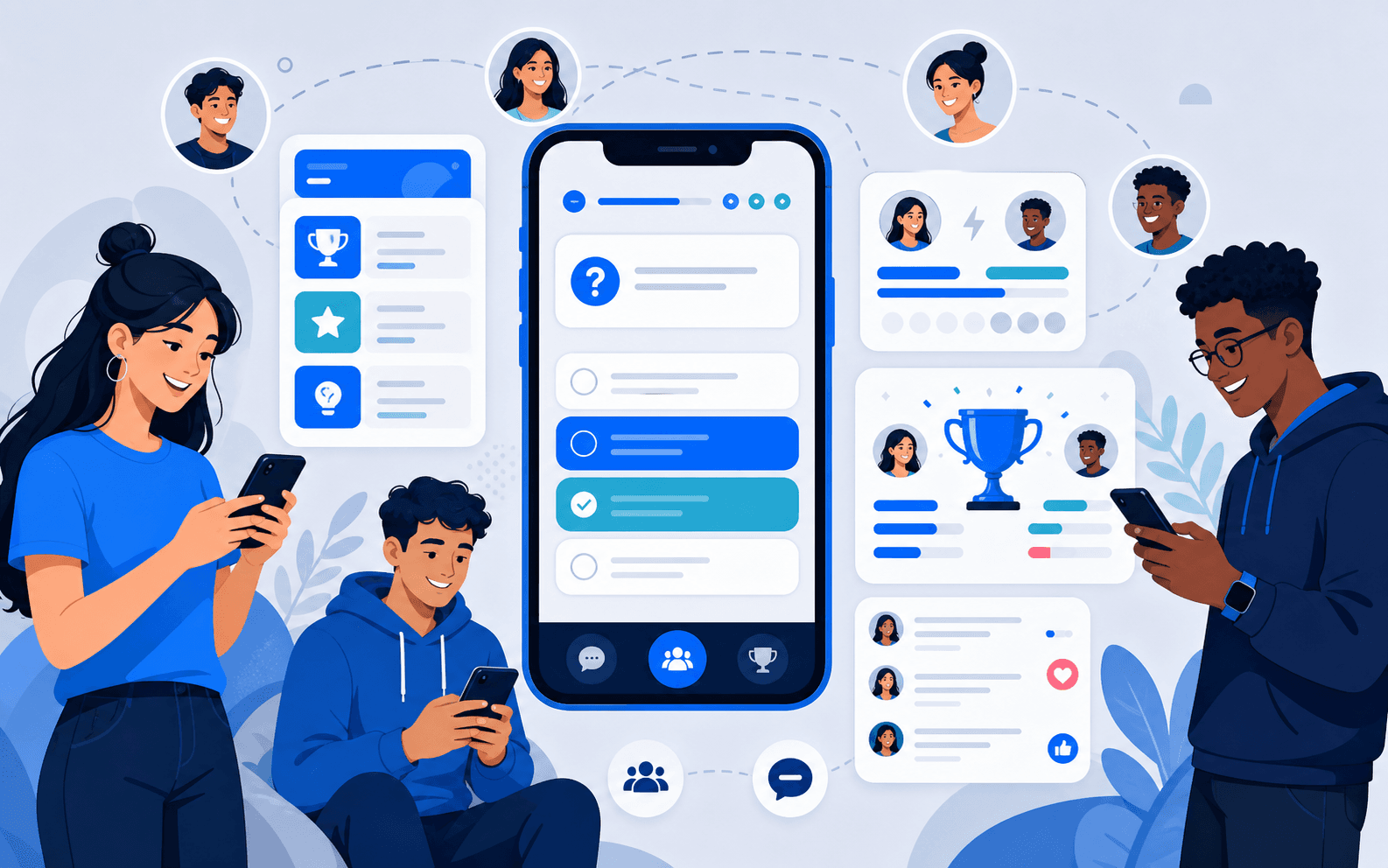
Interface design prioritised getting a player into a game quickly over presenting an elaborate home screen, since friction at the point of starting is the moment a casual player is most likely to simply close the app instead. Once inside a game, consistent interaction patterns, how a question is answered, how a result is shown, meant that switching between an IQ challenge and a knowledge quiz never felt like learning new software. Social elements, seeing others' participation, comparing results, were surfaced deliberately but not aggressively, present enough to make the experience feel connected to other people without turning every screen into a social feed competing with the actual game for attention.
Building the platform
Mobile application
A React Native application carries the full player-facing experience across iOS and Android from a single codebase, keeping quiz and IQ-game screens consistent without duplicating UI work per platform.
Web administration
A React-based web admin panel reuses component patterns familiar to the same engineering team, giving the operations side of the product a consistent technical foundation with the player-facing app.
Backend and real-time updates
Laravel and PHP handle quiz content, scoring, and accounts, with WebSockets delivering real-time updates during live quiz sessions so scores and standings refresh instantly rather than on a manual pull.
Brand and visual identity
Logo and visual identity carry consistently through the entire mobile interface, from game selection through to results, rather than existing only in marketing material separate from the product itself.
Notifications and engagement
Firebase push notifications bring players back for new challenges, while Google-based sign-in and analytics, MailGun, and an SMS gateway support fast onboarding and account communication.
Technology and architecture
- Mobile: React Native builds the primary mobile experience from a single codebase across iOS and Android, keeping quiz and IQ-game screens consistent without duplicating UI work per platform.
- Frontend: React powers the web-based admin panel, reusing component patterns familiar to the same engineering team and speeding up cross-surface development.
- Backend: Laravel and PHP form the backend, handling quiz content, game logic, scoring, and user accounts through a mature framework suited to fast feature iteration.
- Database: MySQL stores structured relational data for users, games, and participation history, where consistent relationships between players, sessions, and scores matter.
- Real-time layer: WebSockets deliver real-time updates during live quiz sessions, so scores, standings, and opponent activity refresh instantly instead of relying on manual refreshes.
- Supporting services: Google APIs provide fast social sign-in and give the team analytics on engagement, Firebase supports push notifications that bring players back for new challenges, MailGun handles transactional email, an SMS gateway supports time-sensitive alerts, and AWS (EC2, Lambda, S3, Route 53) hosts the application and its background and serverless tasks.
Where the build got hard
Making genuinely different game formats, IQ challenges, knowledge quizzes, feel like variations of one product, rather than separate mini-apps stitched together, was the central design and engineering challenge. Reusable interface patterns had to be genuine shared components rather than superficially similar screens built independently, since the latter would have looked consistent at first glance but drifted apart with every future update, quietly reintroducing the fragmented feel the whole approach was meant to avoid.
Keeping real-time updates reliable during live quiz sessions was the second real difficulty, since scoring and standings need to feel instantaneous for a competitive quiz experience to hold together. WebSocket-based delivery addressed the responsiveness requirement, but it also meant designing session state carefully enough that a brief connectivity drop during an active game did not desynchronise a player's view from the actual game state.
Results and impact
The delivered platform brought social interaction and knowledge games into a single mobile product, replacing what could have been a disconnected sequence of quiz screens with one coherent, returnable experience. Reusable interface patterns and a consistent visual identity gave ZeroIQ a recognisable product language across every game format it offered.
The work demonstrates iEncode Tech's ability to connect product identity, interaction design, cross-platform mobile development, backend services, and relational data into a single engagement, capability directly relevant to any consumer product that depends on repeat engagement rather than one-off use.
What this project reinforced
Retention is a product-architecture problem before it is a marketing problem: consistent interaction patterns and a visible, well-scoped social layer do more for repeat use than any single standalone feature. That understanding carries directly into other mobile application development engagements, and it connects to the very different integration approach behind Spark's Discord-linked bidding platform, another product built to complement an existing social dynamic rather than compete with it.
Building a consumer product that depends on people coming back, not just trying it once? Talk to iEncode Tech about product and engineering decisions built around genuine retention, or see the ZeroIQ project overview for a portfolio-style summary of what shipped.